Where Clauses Speak,
and Claws Create Change
Cutting-edge legal scholarship for law students and professionals. Research, analysis and discourse on contemporary legal issues.
100% free publication for all articles — because knowledge should never be behind a paywall.
Trust Law Offices - Advocates & Solicitors
Clause & Claws
Real-time analysis of the most discussed legal topics based on citations, reads, and research momentum.
ClauseRank Trending Topics
ClawsRank Leadership Board
Featured Publications
Peer-reviewed scholarship selected by our editorial board for exceptional research and quality and impact
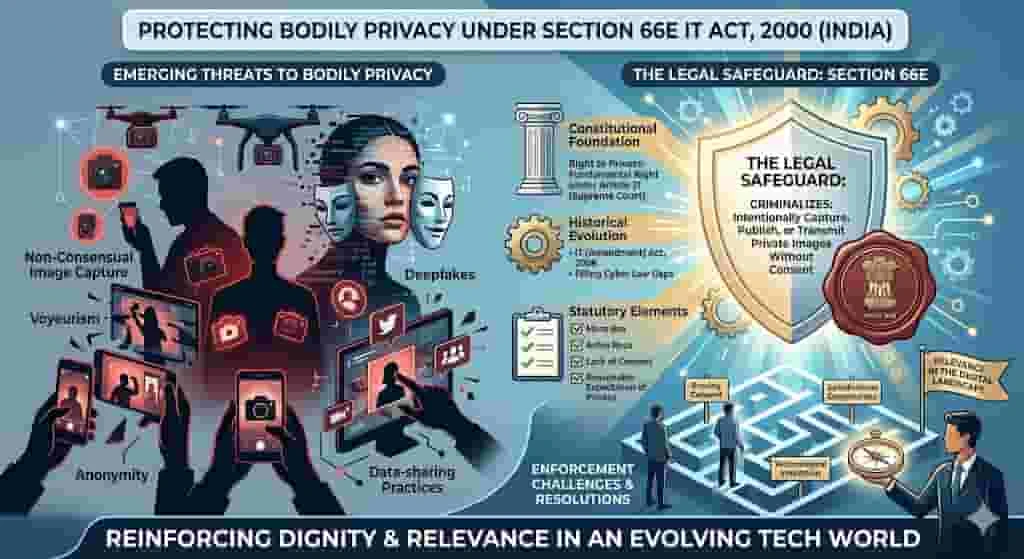
Section 66E of the IT Act 2000: Violation of Privacy
This paper examines Section 66E of the Information Technology Act, 2000 as a safeguard against violations of bodily privacy in the digital age. It outlines the provision’s evolution, its constitutional grounding in the right to privacy under Article 21, and analyzes key elements like consent, mens rea, and reasonable expectation of privacy. The paper also highlights enforcement challenges such as anonymity, jurisdictional issues, and deepfakes and concludes that Section 66E remains crucial for protecting dignity and privacy amid evolving technologies.
26
1
1.11

SEP AND FRAND OBLIGATIONS IN INDIA: AN ANALYSIS OF ABUSE OF DOMINANCE AND CCI’S JURISDICTION UNDER COMPETITION LAW
The greater involvement of technology in the current economies has necessitated standardisation in various industries, including telecommunications, electronics, and digital networks. The fundamental element in this system is the existence of Standard Essential Patents (SEPs). SEPs cover patents whose technologies must be implemented in order to comply with standards. In order to align the rights associated with the protection offered by patents with the need to make technology available, SEP holders are obliged to license the technologies under fair, reasonable, and non-discriminatory terms (FRAND). Nevertheless, the enforcement of FRAND undertakings has posed several legal and economic issues. The present dissertation seeks to explore the emerging case laws regarding the jurisprudence relating to SEPs and FRAND obligations in India, with special reference to the intersection between patent law and competition law.
28
2
1.14

Critical Analysis of the Effectivenes and Accountability of National and State Human Rights Commissions in India: Institutional Response to Human Rights Violations and Protection of Marginalized Group
In India the Protection of Human rights act (PHRA), 1993, established the National Human rights commission (NHRC) and state human rights commission (SHRCs) as the ultimate institutional safeguard against a constitutional and international miscarriage of human rights. The following paper critically assesses the effectiveness and accountability of these Commissions, specifically the issue of their ability to combat systemic human rights violations and marginalized groups. Using a doctrinal research approach, the study shows a structural paradox has existed in the organization since we have a powerful mandate of investigation and promotion which is also consistent with the international Paris Principles but the functionality of the body is awkward due to a statutory lack of punitive/enforcement powers which makes this body to be called a toothless tiger. This weakness is however offset by judicial activism that has secured the quasi-judicial power of the NHRC.
16
1
1.08
Spotlight Authors
Leading scholars and practitioners shaping contemporary legal discourse